Chromatic aberration explained
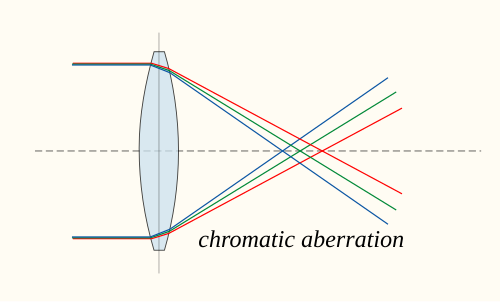
Chromatic aberration is colour fringing caused by a lens focusing different wavelengths of light at slightly different places. Lateral fringes appear towards the frame edges and are easy to remove in editing. Longitudinal fringes appear around out-of-focus areas at wide apertures and are reduced mainly by stopping down.
In short
- Glass bends blue light more than red, so colours do not meet at exactly one point.
- Lateral CA: red/cyan or blue/yellow edges near the corners; fixed well in software.
- Longitudinal CA: purple or green fringes in front of and behind the focus point; reduced by stopping down.
- Special low-dispersion glass and apochromatic designs reduce it at the source.
Why colours split
Glass bends, or refracts, light of different wavelengths by slightly different amounts. This is called dispersion. Blue light usually bends more than red, so a simple lens brings each colour to focus at a slightly different place.
Lens designers combine elements of different glass types to bring colours back together. An achromatic design brings two wavelengths to a common focus; an apochromatic design brings three closer still. Some residual error usually remains.
Lateral (transverse) chromatic aberration
Lateral chromatic aberration means each colour is focused at the same distance but magnified by a slightly different amount. The colours line up in the centre and drift apart towards the edges.
It shows as thin coloured edges, often red and cyan or blue and yellow, on high-contrast lines near the corners, such as branches against the sky. It does not get much better when you stop down.
Longitudinal (axial) chromatic aberration
Longitudinal chromatic aberration means colours focus at different distances. It appears across the whole frame, not only at the edges.
A typical sign is purple or magenta fringes on edges just in front of the focus point and green fringes just behind it. It is strongest at wide apertures on fast lenses and fades as you stop down, because a smaller aperture increases depth of field.
Purple fringing
Photographers often call any purple edge around a bright highlight purple fringing. It is common on backlit branches, window frames and shiny metal.
Several causes can contribute: longitudinal chromatic aberration, flare inside the lens and, with some sensors, light spreading into neighbouring pixels near clipped highlights. Because the causes mix, the exact look varies between lenses and cameras.
Reducing it when you shoot
Stop down by one or two stops to reduce longitudinal fringes (approximate). Avoid placing very bright edges right at the corners if your lens shows strong lateral fringes.
Exposing so that bright highlights are not clipped also helps, because fringes are strongest around blown areas. A lens hood can reduce flare that adds to the problem.
Removing it in editing
Raw editors can remove lateral chromatic aberration very effectively, either from a lens profile or with an automatic option that realigns the colour channels.
Longitudinal fringes need a defringe tool that lowers the saturation of a chosen purple or green hue along edges. Use it carefully: strong settings can grey out real purple or green objects such as flowers or clothing.
Many cameras also correct lateral fringes in their JPEGs automatically.
Frequently asked questions
Does stopping down fix all chromatic aberration?
No. It reduces longitudinal fringes, but lateral fringes near the edges stay much the same. Use the editor's correction for those.
Why do I see fringes only on some photos?
They need high contrast edges, such as dark branches against a bright sky. Low-contrast scenes rarely show them.
Is chromatic aberration the same as flare?
No. Flare is stray light scattered inside the lens. Both can add colour around bright areas, which is why purple fringing is sometimes a mix.
What does apochromatic mean?
It describes a lens design that brings three wavelengths of light to a common focus, which reduces colour fringing more than a simpler achromatic design.


