Metering modes explained
Metering is how the camera measures light to suggest an exposure. Matrix or evaluative metering reads the whole frame, centre-weighted favours the middle, and spot reads a small area. Every meter assumes the scene averages to mid-grey, so very bright or dark scenes need exposure compensation.
In short
- Every reflected-light meter assumes the scene averages to a mid-tone.
- Matrix or evaluative metering is the best default for most scenes.
- Spot metering gives precise control but only reads a few percent of the frame.
- Snow, white walls and black subjects need exposure compensation whichever mode you use.
What a meter actually does
Your camera measures light reflected from the scene and turns it into an exposure suggestion: a combination of aperture, shutter speed and ISO. It cannot know whether a subject is a white cat or a black cat; it only sees how much light comes back.
So the meter assumes the scene averages to a middle tone, often described as mid-grey. When the scene really is average, the result looks right. When it is mostly bright or mostly dark, the meter is fooled.
Matrix or evaluative metering
This mode, named differently by different makers, divides the frame into many zones and compares their brightness, often with colour, focus distance and a database of typical scenes. It then picks an exposure that tries to keep the important parts well exposed.
It is the best starting point for landscapes, travel and everyday photography. Its weakness is that it is hard to predict: you cannot always tell why it chose a setting, so check the histogram on tricky scenes.
Centre-weighted metering
Centre-weighted metering reads the whole frame but gives extra weight to the middle, roughly the central circle. It is simple and predictable, which is why many experienced photographers like it.
It suits portraits and subjects placed near the centre. If your subject sits at the edge of the frame, meter with it in the centre, lock the exposure, then recompose.
Spot and partial metering
Spot metering reads only a small circle, roughly 1–5% of the frame depending on the camera (approximate). Partial metering reads a slightly larger area. Some cameras link the spot to the active focus point.
Use it when a small subject sits against a very different background: a performer under a spotlight, a backlit face, the moon. Meter a mid-tone area such as skin or grass, not the brightest highlight or the deepest shadow, unless you then compensate deliberately.
When each mode fails
Snow, beaches and white walls look grey because the meter pulls them down to mid-tone; add about +1 to +2 stops of compensation (approximate). Black animals, dark clothing and night streets come out too bright; subtract about −1 to −2 stops.
Strong backlight can make matrix metering expose for the sky and leave the subject as a silhouette. Spot metering on a tiny bright area can plunge everything else into darkness. Knowing these traps is more useful than memorising the modes.
Checking and correcting
Exposure compensation shifts the meter's suggestion up or down in semi-automatic modes. Auto exposure lock (AE-L) freezes a reading so you can recompose. In manual mode, the meter scale shows how far you are from its suggestion.
The histogram is the best check: if it is bunched against the right edge, highlights are clipping; if it is bunched to the left, shadows are crushed. Adjust and shoot again.
Frequently asked questions
Which metering mode should I use as a default?
Matrix or evaluative metering works well for most situations. Switch to spot or centre-weighted when a small or central subject is much brighter or darker than its surroundings.
Why are my snow photos grey?
The meter tries to make the bright scene average, so it underexposes. Add about one to two stops of exposure compensation (approximate) and check the histogram.
Does metering mode matter in manual mode?
Yes. The meter still reads the scene and shows its suggestion on the scale; the mode decides which part of the frame that reading is based on.
Is a handheld light meter still useful?
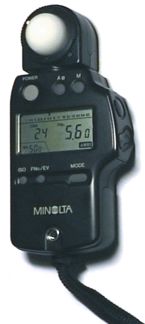
An incident meter measures light falling on the subject rather than light reflected from it, so it is not fooled by white or black subjects. Many studio and film photographers still use one.


